Insights

Branded Resale vs. Third-Party Marketplaces

Third-party marketplaces create resale activity. 
Branded resale turns that activity into a channel your brand owns.

April 06,2026
8 min read
Branded Resale vs. Third-Party Marketplaces

What is third-party resale?

Third-party resale happens when pre-owned products are bought and sold through external marketplaces such as Vinted, Depop, Vestiaire Collective, eBay or similar platforms.

These marketplaces make it easy for consumers to list and discover secondhand products. They already have traffic, buyer demand and established marketplace mechanics. For individual sellers, this can be highly convenient.

For brands, however, third-party resale usually happens **outside their direct control**. The brand may benefit from continued product demand, but it does not own the resale experience, the customer data, the product presentation or the ongoing relationship with the buyer and seller.

What is branded resale?

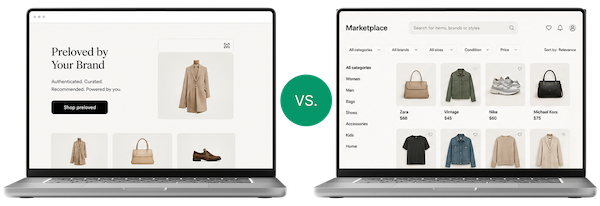
Branded resale is a resale experience operated under a brand’s own identity. Instead of sending customers to an external marketplace, the brand offers its own resale channel — for example through a branded pre-loved shop, trade-in program, peer-to-peer marketplace or managed resale model.

This gives the brand more control over:

  • the customer journey,
  • the visual presentation of products,
  • listing standards and moderation,
  • trust and authentication processes,
  • loyalty integration,
  • data collection,
  • and the long-term commercial value created by resale.

In other words, branded resale turns secondhand demand from an external activity into a strategic channel that can support retention, customer lifetime value and circular business growth.
 

Branded resale vs. third-party marketplaces: key differences

Criteria Branded resale Third-party marketplace
Brand control High Low
Customer data Owned by brand Owned by marketplace
UX control Full Limited
Loyalty integration Possible Limited
Brand storytelling Strong Weak
Pricing context Controlled Marketplace-driven
Product presentation Brand-led Standardized by marketplace
Trust model Defined by brand Defined by platform
Customer relationship Direct Intermediated
Long-term business value Builds brand ecosystem Builds marketplace ecosystem
  • Customer ownership

    A branded resale platform gives brands more than a new sales channel. It helps them keep resale connected to their own customer ecosystem.

  • Brand control

    through repeat resale interactions and additional brand touchpoints.

  • Data ownership

    without relying only on first-hand product sales.

  • Trust and authentication

    by creating additional circular inventory pathways.

  • Customer loyalty

    into resale demand, customer behavior, and product longevity.

  • Long-term business value

    into resale demand, customer behavior, and product longevity.

Build resale inside your own ecosystem

Third-party marketplaces prove that customers want secondhand options. 
A branded resale platform helps brands turn that demand into a channel they can actually own.

Frequently asked questions

Not in every case. Third-party marketplaces can be useful for reach, liquidity and convenience. Branded resale is typically better when a brand wants more control over customer experience, data, loyalty, product presentation and long-term commercial value.

Yes. The two models are not always mutually exclusive. Some brands may continue to have products circulating on external marketplaces while also building a direct resale channel for customers who prefer a branded experience.

Resale data can reveal how products behave after the first sale, which customers participate in circular flows, which items retain value and where new retention opportunities exist. That information can support CRM, merchandising, product strategy and future business decisions.

Not necessarily. The right setup depends on the operating model. Some brands may start with a simple branded resale experience, while others need more advanced marketplace infrastructure, seller onboarding, moderation, payments, payouts and reporting from the beginning.

No. Branded resale can be relevant for fashion, outdoor, sports, lifestyle, childrenswear, home goods and other categories where products have a meaningful second life and where the brand benefits from staying connected to that lifecycle.

Thinking about launching your own resale channel?

Ready to get Started?

Thinking about launching your own resale channel?

Let’s discuss the right model for your brand