No. Mid-size and growing brands can also launch branded resale if the model, scope, and operating requirements are defined clearly from the start.

Insights
A branded resale platform enables customers to buy and sell pre-owned products within a brand-owned marketplace, while the brand retains control over the customer experience, data and relationships.
For fashion and lifestyle brands, resale is becoming a strategic channel.
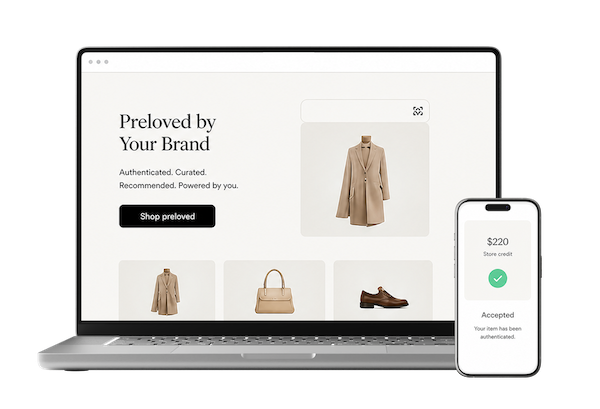
In a branded resale model, the resale experience is integrated into the brand’s own digital ecosystem instead of being fully outsourced to a generic secondhand marketplace.
A typical flow looks like this:
The exact model can vary. Some brands use peer-to-peer resale, others offer trade-in, managed resale, brand-owned inventory, or hybrid approaches. The common principle is that the brand owns the customer-facing resale experience.
Brands are entering resale because it can support both commercial and strategic goals.
A branded resale platform can help a brand:
This is why branded resale is increasingly positioned not only as a sustainability topic, but as part of modern retail growth, customer retention, and recommerce strategy. Industry providers such as Trove and ThredUp now frame branded resale around growth, profitability, and customer value in addition to circular impact.
| Capability | Branded resale platform | Third-party marketplaces |
|---|---|---|
| Brand experience | Fully aligned, on-brand experience | Fully aligned, on-brand experience |
| Customer relationship | You own the customer and data | Platform owns the customer |
| Pricing & margin | You set the rules and capture value | Marketplace takes a commission |
| Inventory control | Curate what is accepted and sold | Limited control over listings |
| Marketing & loyalty | Integrate with your CRM and loyalty programs | Limited integration |
| Sustainability reporting | Measure and report your impact | Minimal brand-level reporting |
A branded resale platform gives brands more than a new sales channel. It helps them keep resale connected to their own customer ecosystem.
through repeat resale interactions and additional brand touchpoints.
without relying only on first-hand product sales.
by creating additional circular inventory pathways.
into resale demand, customer behavior, and product longevity.
No. Mid-size and growing brands can also launch branded resale if the model, scope, and operating requirements are defined clearly from the start.
No. Branded resale usually complements first-hand commerce. It can create additional customer touchpoints and help brands serve different customer segments across the product lifecycle.
Yes. Many brands begin with a focused resale scope and then expand categories, workflows, integrations, and operational depth over time.
ResalePreloved helps fashion and lifestyle brands launch branded resale experiences with the infrastructure needed to manage marketplace operations under their own brand.
No. Mid-size and growing brands can also launch branded resale if the model, scope, and operating requirements are defined clearly from the start.
